


|
|
|
|
|
|||
| ||

|
|
"The New York rowhouse," writes Charles Lockwood in Bricks and Brownstones, "...incorporated several architectural features peculiar to the city. The first-floor parlors rose anywhere from three to twelve feet above the street on a high basement, and therefore, a flight of steps known as a 'stoop' was necessary to reach the front door."
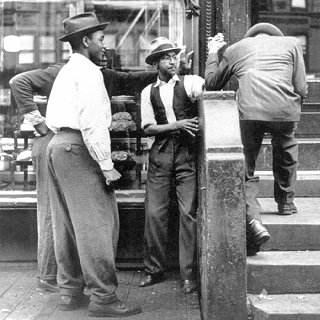 1941: Arm wrestling in Harlem, Manhattan (Andreas Feininger, courtesy of the New York Historical Society, NY) The term derives from the Dutch stoep; in the Netherlands it was used to raise the main floor of the house in areas subject to flooding. The stoop persisted in Dutch New York, not as a flood measure but, as architectural historian Andrew Dolkart argues, because it provided a liveable, partially above-ground basement in a city which even in the nineteenth century was becoming pressed for space. Although they did exist elsewhere, "nowhere was the stoop as universal a feature or on so grand a scale as in New York."
|
|
Streetplay home |
What's new? |
About us |
Contact us |
Streetplay blog |
SPWiki: The Streetplay Wiki Copyright ©2024 Streetplay.com. Use, retransmission, or duplication of any portion of this site (unless otherise noted) without the permission of Streetplay.com is prohibited. |





